


MineOS
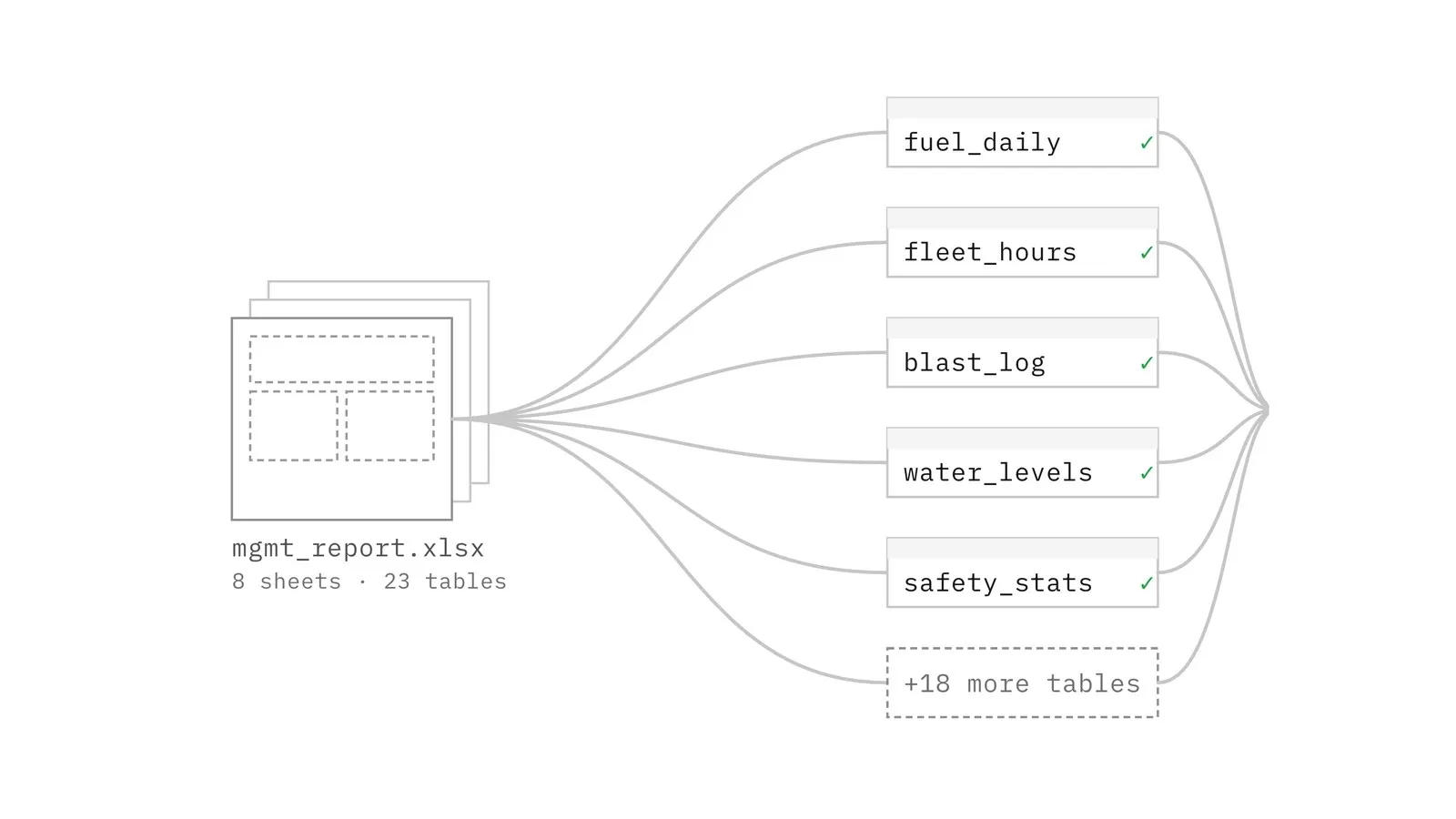
Stop waiting on month-end to find out what happened. MineOS reads your spreadsheets as they are — merged headers, tables stacked on one sheet, a TOTAL row in the middle — and lands every one in a database, traced back to the file, sheet and row it came from. Your departments keep making the same spreadsheets they make today.
The problem
Every management report on site is someone copy-pasting between a dozen files. Generic import tools are built for tidy data — customer lists, product catalogues, transaction exports. Site operations do not produce tidy data. They produce a workbook a department has been refining for nine years, and nobody there has time to reformat it.
- The number arrives at month-end: a problem that started in week one gets found in week five, in a meeting, by the person least able to do anything about it
- Ask where a figure came from and the answer is a memory — which tab, which version, which of the three copies on the shared drive
- The logic lives in one workbook one person maintains, and everyone knows what happens the week they are on leave
Our solution
MineOS doesn’t replace that person or their spreadsheet. It gives what they built a home that keeps working the week they’re not in the room.
Most “get the data in” projects end as a folder of import scripts one person understands. MineOS ends as a database — every file type your companies produce becomes a named, versioned object, and every file of that kind parses the same way from then on. Not the clean CSV of a product demo: the actual workbook, however many sheets it has grown to. MineOS finds where each table starts and stops and lands each one typed. You reformat nothing.
Self-hosted on your own network, so the data never leaves it.
What’s in MineOS
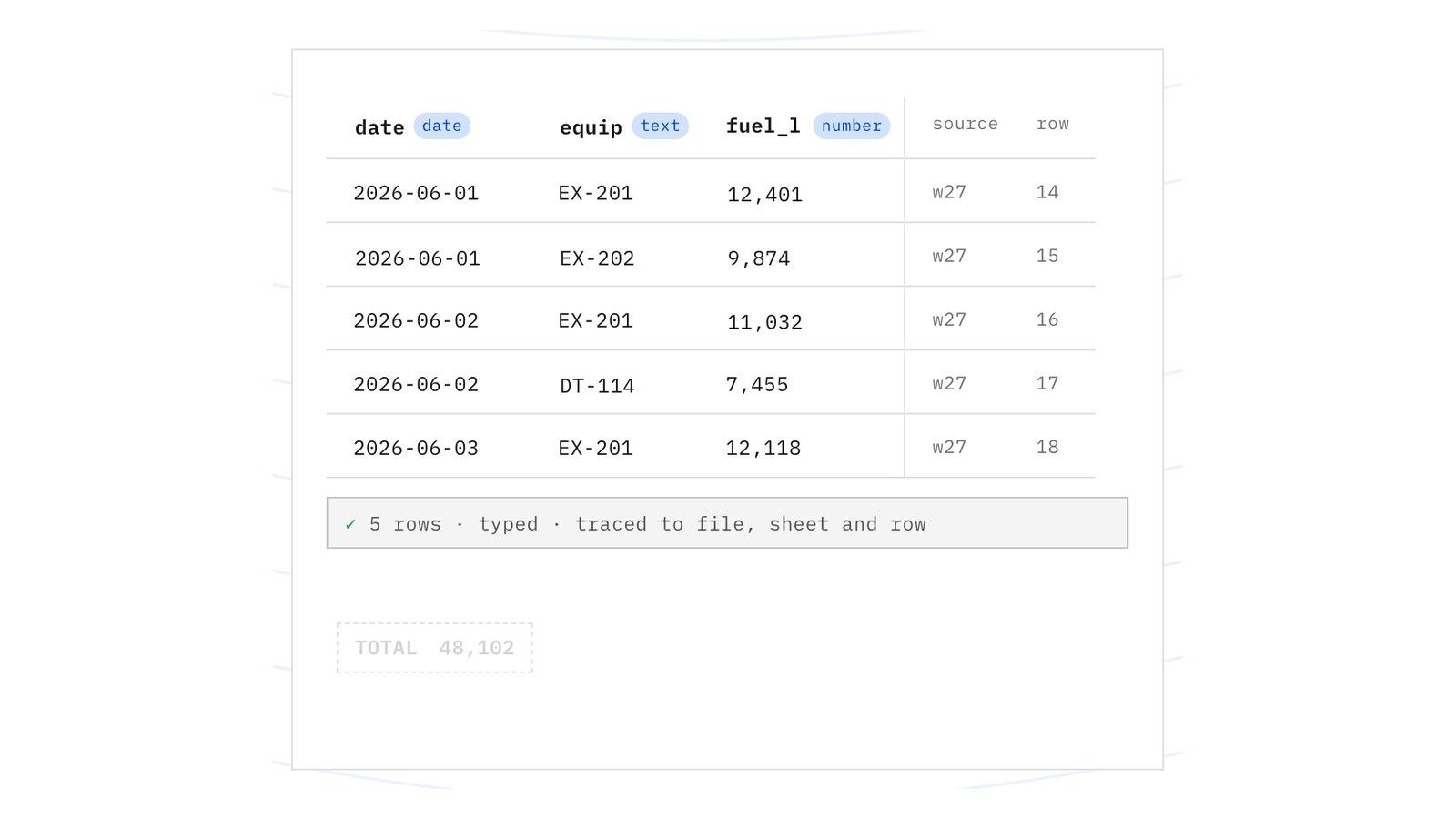
- Every table says what is in it: how many rows, what date range, which file types fed it
- Every row keeps its address — traced to the file, the sheet and the row it came from, not to a batch
- The original workbook is stored intact and never modified; when an auditor asks, you open the actual file
- Every file type your companies produce becomes a named, versioned object, and every file of that kind parses the same way from then on
- Each company keeps its own file types and tables inside the one database, and one set of dashboard definitions covers all of them
- Teaching it a file is clicking on the file: you click the table you want and it proposes the columns, the types and the header row
- Ask a dashboard a question and get the SQL and the rows with the answer
- .xlsx, .xlsm and .csv — several tables stacked on one sheet, a merged three-row header, a table running sideways
- Self-hosted on your own network — the data never leaves it
- Certified to ISO/IEC 27001:2022
- 24/7 support for urgent requests
- Support in English, French and Russian
- Founded in Toronto, 2021
Book a 30-minute scoping call
Tell us how MineOS would sit in your operation. An engineer replies.
Contact us